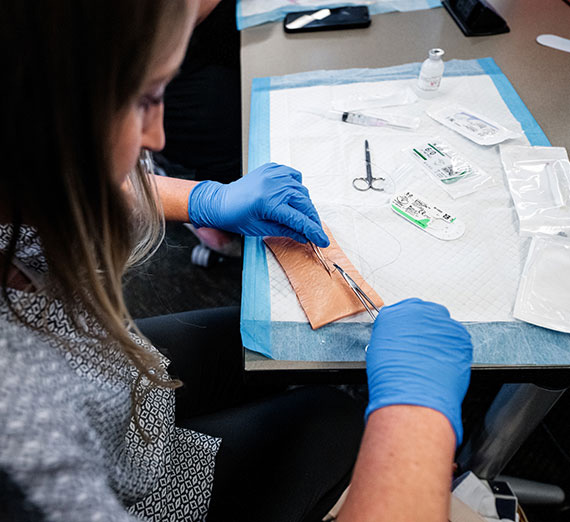
Our master’s degree in nursing education program helps prepare you to work as a nursing educator in bachelor and associate degree programs, health care staff development, continuing education programs, or community education programs. You will learn how to create curricula and plan, revise, implement, and evaluate programs. Nurse Educators work in both educational and practice settings to teach other nurses or to help educate the community on best practices or health concerns.
NURSING
MASTERS (MSN)
Nurse Educator Option: 36 Credits
This option prepares Registered Nurses (NE) to work as educators in academic, hospital, and community-based settings. Students develop an area of clinical specialization as well as competency in curriculum development, teaching-learning strategies, and assessment of student learning. You will learn how to create curricula and plan, revise, implement, and evaluate programs.Particular emphasis is placed on tailoring content and practicum experiences to individual needs. Practicum experiences take place in a variety of educational settings. There is a required two-day, on-campus immersion during the last practicum course.
Please click here to learn more about our Nurse Educator track.
Health Systems Leadership Option: 36 Credits
This option prepares registered nurses to assume leadership and administrative positions in inpatient, outpatient, community-based, and academic settings. Students gain knowledge and competency in financial and human capital management, as well as strategies for responding to the ethical and legal issues encountered in administrative roles. In today’s health care environments, strong leadership is essential for quality patient care. Health Care Administrators must be prepared to deal with changing health care delivery systems, technological innovations, an increasingly complex regulatory environment, restructuring of work, and an increased focus on preventive care.The HSL core courses are offered online. Practicum experiences are arranged by the student to meet identified learning needs. There is a required two-day, on-campus immersion during the last practicum course.
Please click here to learn more about about our Health Systems Leadership track.
Family Nurse Practitioner Option: 36 Credits
This option prepares students to provide a holistic approach to primary care for individuals and families of all ages and to manage a wide variety of acute and chronic health problems. Family Nurse Practitioners work in independent as well as collaborative practice settings, such as private practices, urgent care centers, health maintenance organizations, clinics, health departments, student health centers, and clinics for the homeless or uninsured. The FNP core courses are offered online. When students begin their practicum courses, they are required to participate in two on-campus immersions during each of the three practicum courses as well as when taking the Advanced Health Assessment course. These immersions are two days in length. Students residing in Washington, Idaho, Oregon, and Montana also have at least one site visit from a clinical faculty during each practicum course. Students living outside of this four-state region are required to arrange for an additional on-campus day in conjunction with one of the immersions during each practicum course in order to complete the faculty site visit requirement.
Click here to learn more about the Family Nurse Practitioner track.
Psychiatric Mental Health Nurse Practitioner Option: 36 Credits
This option prepares students to work as Psychiatric-Mental Health Nurse Practitioners. They are prepared to provide the full range of services that comprise primary mental health care in diverse settings with a variety of clients/patients, to provide clinical and professional leadership, and facilitate system improvements. Their clinical practice focuses on persons of all ages with diagnosed psychiatric disorders and individuals, families, or populations at risk for mental illness. The PMHNP core courses are offered online. When students begin their practicum courses, they are required to participate in one on-campus immersion during each of the four practicum courses and two on-campus immersions when taking the Advanced Health Assessment course. These immersions are two days in length. Students also have at least one site visit from a clinical faculty during two of the practicum courses. Additional site visits are arranged as needed.
Click here to learn more about the Psychiatric-Mental Health Nurse Practitioner track.
Second Master's Degree: 21-38 Credits
Family Nurse Practitioner Option: 29-32 Credits
This option prepares students to provide a holistic approach to primary care for individuals and families of all ages and to manage a wide variety of acute and chronic health problems. Family Nurse Practitioners work in independent as well as collaborative practice settings, such as private practices, urgent care centers, health maintenance organizations, clinics, health departments, student health centers, and clinics for the homeless or uninsured. The FNP core courses are offered online. When students begin their practicum courses, they are required to participate in two on-campus immersions during each of the three practicum courses as well as when taking the Advanced Health Assessment course. These immersions are two days in length. Students residing in Washington, Idaho, Oregon, and Montana also have at least one site visit from a clinical faculty during each practicum course. Students living outside of this four-state region are required to arrange for an additional on-campus day in conjunction with one of the immersions during each practicum course in order to complete the faculty site visit requirement.
Psychiatric-Mental Health Nurse Practitioner (across the life span) Option: 35-38 Credits
This option prepares students to work as Psychiatric-Mental Health Nurse Practitioners. They are prepared to provide the full range of services that comprise primary mental health care in diverse settings with a variety of clients/patients, to provide clinical and professional leadership, and facilitate system improvements. Their clinical practice focuses on persons of all ages with diagnosed psychiatric disorders and individuals, families, or populations at risk for mental illness. The PMHNP core courses are offered online. When students begin their practicum courses, they are required to participate in one on-campus immersion during each of the four practicum courses and two on-campus immersions when taking the Advanced Health Assessment course. These immersions are two days in length. Students also have at least one site visit from a clinical faculty during two of the practicum courses. Additional site visits are arranged as needed.
Health Systems Leadership Option: 21-24 Credits
This option prepares registered nurses to assume leadership and administrative positions in inpatient, outpatient, community-based, and academic settings. Students gain knowledge and competency in financial and human capital management, as well as strategies for responding to the ethical and legal issues encountered in administrative roles. The HSL core courses are offered online. Practicum experiences are arranged by the student to meet identified learning needs. There is a required two-day, on-campus immersion during the last practicum course.
Nurse Educator Option: 21-24 Credits
This option prepares Registered Nurses to work as educators in academic, hospital, and community-based settings. Students develop an area of clinical specialization as well as competency in curriculum development, teaching-learning strategies, and assessment of student learning. Particular emphasis is placed on tailoring content and practicum experiences to individual needs. The NE core courses are offered online. Practicum experiences take place in a variety of educational settings. There is a required two-day, on-campus immersion during the last practicum course.